TEACHING RESOURCE
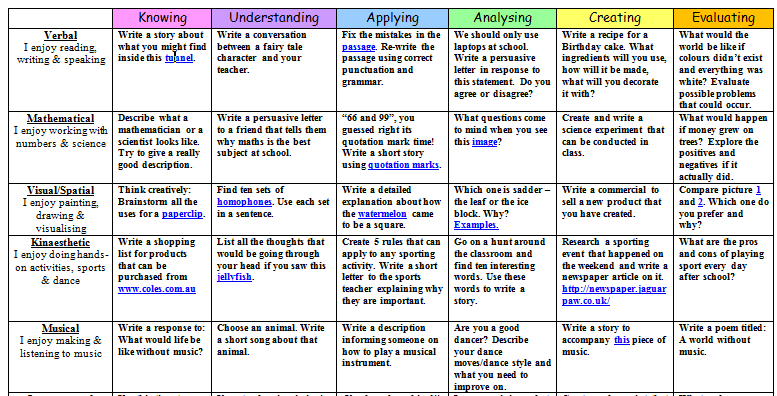
Bloom’s and Gardner’s Writing Matrix for Years 3/4/5
Published: 7 Jan 2014
DownloadSummary:
This writing matrix is directly linked to blooms taxonomy and Gardner’s multiple intelligences. It includes a wide range of writing activities for your lesson plans that cover multiple areas and year levels in the Australian Curriculum. The document is hyperlinked which allows students to digitally access resources and allowing teachers to digitally display resources. The hyperlinks include links to pictures, internet sites as well as extra information to remind students of particular concepts.
The matrix allows students to develop their critical thinking and creativity skills. It caters for learner diversity and individual differences/learning styles. Students can work on activities at their own pace or the teacher can set specific activities that need to be completed during writing/English time.
We want our students to be producing high quality work, experience success and develop a sense of pride. Thus we need to discourage students from rushing through all of the activities. They should be worked at slowly and gradually over several weeks. Point systems can be implemented to help with this. Assign a point value e.g. 20 points that must be achieved by the end of the week. Students will only be given 1 point for poorly completed work and at teacher discretion, they should complete it again. 5 points may be awarded for exceptional work etc…
Australian Curriculum Links:
Year 3
- (ACELA1479)Understand that paragraphs are a key organizational feature of written texts
- (ACELA1484)Learn extended and technical vocabulary and ways of expressing opinion including modal verbs and adverbs
- (ACELT1791)Create texts that adapt language features and patterns encountered in literary texts, for example characterisation, rhyme, rhythm, mood, music, sound effects and dialogue
- (ACELT1596)Draw connections between personal experiences and the worlds of texts, and share responses with others
- (ACELY1679)Read an increasing range of different types of texts by combining contextual, semantic, grammatical and phonic knowledge, using text processing strategies, for example monitoring, predicting, confirming, rereading, reading on and self-correcting
- (ACELY1682)Plan, draft and publish imaginative, informative and persuasive texts demonstrating increasing control over text structures and language features and selecting print,and multimodal elements appropriate to the audience and purpose
Year 4
- (ACELA1496)Explore the effect of choices when framing an image, placement of elements in the image, and salience on composition of still and moving images in a range of types of texts
- (ACELA1780)Recognise homophones and know how to use context to identify correct spelling
- (ACELY1694)Plan, draft and publish imaginative, informative and persuasive texts containing key information and supporting details for a widening range of audiences, demonstrating increasing control over text structures and language features
- (ACELY1692)Use comprehension strategies to build literal and inferred meaning to expand content knowledge, integrating and linking ideas and analysing and evaluating texts
- (ACELT1607)Create literary texts that explore students’ own experiences and imagining
- (ACELT1604)Use metalanguage to describe the effects of ideas, text structures and language features of literary texts
Lesson:
This writing matrix can easily be integrated to support any writing program. It can be utilised during creative writing time or alongside a normal writing lesson. The activities can be adapted to suit the needs of your students. It is important to make sure that your students have been taught specific writing conventions before completing some of the activities. Teaching about homophones, how to write a letter, newspaper conventions etc… need to be done before the students complete the activities.
Discuss multiple intelligences with students. They are the ways in which we learn best and we all learn differently.
You can set specific activities for students to complete or you can allow them to choose freely.
Assessment:
Most of the activities will be recorded in students writing books. Have a set time each day for students to hand up their writing books and have them returned to them by the end of that day. This is crucial and allows students to know that their work is valued and you will give them feedback.
Resources:
Download the Matrix below (please note that you will have to change the hyperlinks in the matrix to point to where you save the hyperlink file):
Bloom’s and Gardner’s Writing Matrix (PDF)
Bloom’s and Gardner’s Writing Matrix.doc (WORD)
Writing Matrix Hyperlink File (WORD)
[wpfp-link]
Image references in Linked Page:
Paperclip: archived source unavailable
Watermelon: archived source unavailable
Leaf: http://fineartamerica.com/featured/fall-leaf-carlos-caetano.html
Ice-block: http://www.clker.com/clipart-3947.html
Playground: http://www.styleroom.se/album/26694
Beach: http://media-cache-ec0.pinimg.com/originals/24/36/29/243629cddb31e46848a393bedc165e54.jpg
Jellyfish: archived source unavailable
Quotation marks poster: archived source unavailable
If you like this lesson, or have an idea to improve it, please consider sharing it on Twitter, Pinterest and Facebook or leave a comment below.