TEACHING RESOURCE
Using Wordle.net to Teach Children Predicting in Reading
Published: 25 Sept 2012
View Lesson PlanSummary:
In this lesson, children of all year levels can use an image created from Wordle.net to predict what an article/story is about. There is a massive hype over who is correct in this lesson and it caters to your lowest readers and your highest readers. I love this lesson because it helps your low readers to understand all the words in the article first, allowing them to read the text fluently later.
Australian Curriculum Links:
- Year 1 – Read supportive texts using developing phrasing, fluency, contextual, semantic, grammatical andphonic knowledge and emerging text processing strategies, for example prediction, monitoring meaning and rereading (ACELY1659)
- Year 2 – Read less predictable texts with phrasing and fluency by combining contextual, semantic, grammatical and phonic knowledge using text processing strategies, for example monitoring meaning, predicting, rereading and self-correcting(ACELY1669)
- Year 3 – Read an increasing range of different types of textsby combining contextual, semantic, grammatical and phonic knowledge, using text processing strategies, for example monitoring, predicting, confirming, rereading, reading on and self-correcting (ACELY1679)
- Year 4 – Read different types of texts by combining contextual , semantic, grammatical and phonic knowledge using text processing strategies for example monitoring meaning, cross checking and reviewing(ACELY1691)
- Year 5 – Navigate and read texts for specific purposes applying appropriate text processing strategies, for example predicting and confirming, monitoring meaning, skimming and scanning (ACELY1702)
Lesson Outline:
Before you do this, choose an appropriate article/story/speech for your children. You can use a picture story book for younger students.
Introduction:
- Explain what prediction is and how it helps us as readers to understand whatever it is that we are reading.
- Discuss where and when we would predict in our lives (and in reading) on the board (2 -Heading T Chart would work well).
- Tell students that today we are going to practise predicting with a tricky and challenging image that will require them to think critically.
Body:
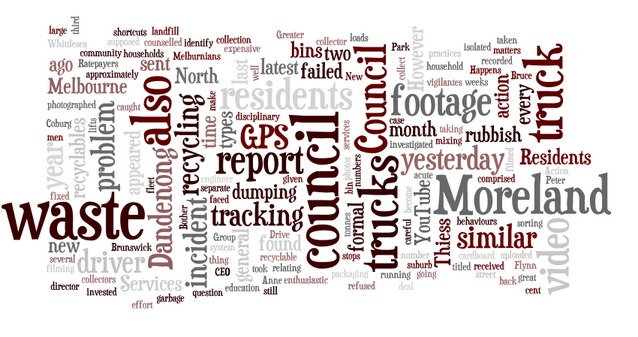
- Pull up your wordle (you’ll need to create one first by copying text from an article/story into the Java plugin at
archived source unavailable) and distribute colour copies to pairs in your class. - Set students the challenge that you have copied this text from a newspaper article that you have forgotten the name of and challenge them to solve what the article is about.
- Explain to the children that in a wordle, the words that appear the largest, occur more often in the text. The example above obviously has the word ‘WASTE’ appear quite often.
- Discuss the strategies that we could use as readers to try and make meaning from this text (it is a text you know), such as using a dictionary to look up unknown words, finding proper nouns for places and looking them up on a map, etc.
- Set children to task, getting them to record any information that they find out and their thoughts on what the text is about.
Conclusion
- After children have spent a good 20-30 minutes examining the Wordle, wander off to a stack of mixed up papers that you have previously created (have copies of the original article here for the students too) and yell out ‘It’s ok! I’ve found the article!’
- Naturally students will want to know (confirm or deny) their predictions and will ask if they can read it.
- Before you allow them, ask for some of their predictions first and record on a large piece of paper (butcher’s paper will work well)
- Have students read in pairs, small groups or as a whole class.
- When they have finished ask them to come and place a tick or a cross on some of the predictions that the class made and discuss why these predictions were incorrect/correct.
- Conclude by pointing out that we can always predict what might happen, but that prediction can always change as we learn more. Good predictions take in a lot of factors and are not just ‘wild’ guesses.
Assessment:
- Use anecdotal notes recording (grid with what strategies you are looking for works well).
- Add initials to children’s predictions on the butcher’s paper to see who has contributed.
- Have children record their reading and create a before and after digital prediction and affirmation.
Resources:
- The above wordle used this article http://www.theage.com.au/victoria/hightech-tactics-fail-to-stop-recycling-racket-20120924-26hll.html