TEACHING RESOURCE
Year 2 English Narrative Writing Basics: Characters, Setting, and Problem
Published: 3 Oct 2025
View Lesson PlanDescription
This 5-lesson unit introduces Year 2 students to the core elements of narrative writing: characters, setting, and problems. Students explore how authors build stories by creating memorable characters, describing where the story happens, and introducing a central problem to drive the plot. Through guided activities, modelled writing, and independent practice, students will build confidence in planning and writing their own short narratives.
Curriculum Links (Australian Curriculum v9)
English – Year 2
- AC9E2LA03: Identify how texts across the curriculum are organised differently and use language features depending on purposes.
- AC9E2LE02: Use interaction skills when engaging in discussions, expressing ideas clearly and listening to others.
- AC9E2LE03: Create and edit literary texts by experimenting with character, setting, events and ideas.
- AC9E2LY05: Create short texts for a range of purposes, including recounts and narratives, using growing knowledge of text structures and language features.
Unit Overview
| Lesson | Focus | Key Outcome |
|---|---|---|
| 1 | What is a narrative? | Identify and explain the structure of a simple narrative. |
| 2 | Creating characters | Develop characters using descriptive words and drawings. |
| 3 | Exploring settings | Describe story settings using sensory details. |
| 4 | Introducing a problem | Recognise and create problems that drive a story. |
| 5 | Putting it all together | Plan and draft a short narrative using characters, setting, and problem. |
Lesson 1: What is a Narrative?
Time: 60 minutes
Learning Intention:
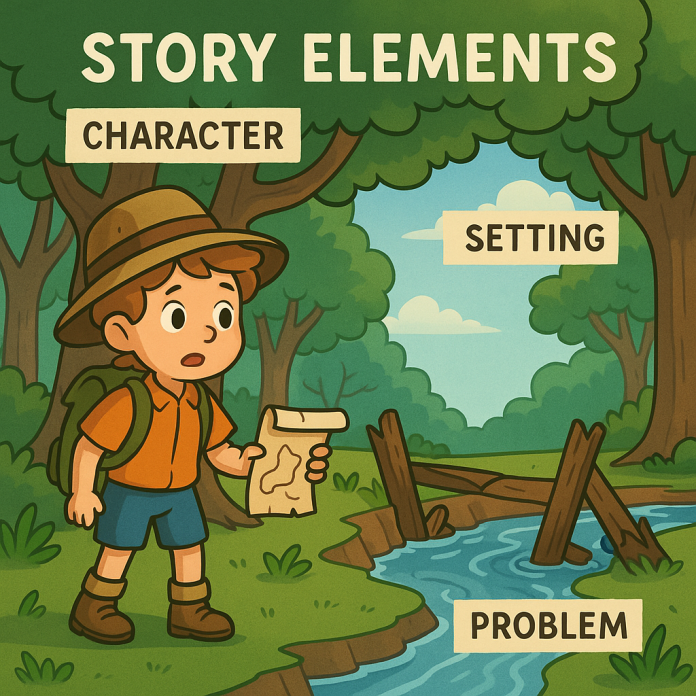
We are learning to identify the main parts of a story: characters, setting, and problem.
Success Criteria:
I can explain what a narrative is and point out the characters, setting, and problem in a story.
Lesson Breakdown
0–10 mins: Warm-Up – Read Aloud
- Teacher: “Today we are going to learn about narratives. Narratives are stories that entertain us. They usually have characters, a setting, and a problem. Let’s listen carefully to this story and see if we can find those things together.”
- Read aloud a familiar short text (The Three Little Pigs, The Gruffalo, or similar).
- Pause occasionally: “Who are the characters here? Where are they? What is going wrong?”
10–25 mins: Explicit Teaching – Narrative Structure
- Draw a simple story mountain or beginning–middle–end chart on the board.
- Teacher Script: “Narratives usually start by introducing characters and setting. Then something happens — a problem! The problem makes the story interesting. Finally, the story ends when the problem is solved.”
- Together, fill the chart with details from the read-aloud story.
25–45 mins: Guided Practice – Story Dissection
- Provide a worksheet with headings: Characters, Setting, Problem.
- Work as a class to complete one section, then have students complete the rest in pairs.
- Teacher Prompt: “Turn to your partner and tell them who the characters are. Then write them down.”
45–55 mins: Independent Activity – Story Map
- Students create a simple story map (drawing or writing) for the text.
55–60 mins: Reflection
- Invite 2–3 students to share their story maps.
- Teacher: “Today we learnt that all narratives have characters, settings, and problems. Tomorrow we’ll create our own characters.”
Assessment: Check worksheets and story maps for ability to identify story elements.
Differentiation:
- Support: Provide pre-labelled boxes with word banks (e.g., pig, wolf, forest).
- Extension: Ask students to identify how the problem was solved (solution).
Lesson 2: Creating Characters
Time: 60 minutes
Learning Intention:
We are learning how to create interesting characters for our stories.
Success Criteria:
I can describe a character’s appearance, feelings, and actions.
Lesson Breakdown
0–10 mins: Warm-Up – Character Brainstorm
- On the board, write “Characters I love.”
- Teacher Prompt: “Think of your favourite story character. What do they look like? What do they do?”
- Create a class brainstorm (e.g., Harry Potter – has glasses, brave, uses magic).
10–25 mins: Explicit Teaching – Character Description
- Model describing a new character on the board.
- Teacher Script: “Let’s make up a character. I’ll draw a girl named Ruby. She has red hair, wears big boots, and she loves to explore. She feels excited when she discovers new things.”
- Highlight use of adjectives (red hair, big boots) and verbs (explores).
25–45 mins: Guided Practice – Character Profile
- Hand out character profile templates (name, looks, likes/dislikes, feelings, actions).
- Teacher Instruction: “Work in pairs. Choose a new character and fill in your profile. Remember to use describing words.”
45–55 mins: Independent Activity – Character Drawing
- Students draw their character and write 2–3 descriptive sentences.
55–60 mins: Reflection
- Teacher Prompt: “Who would like to read a sentence about their character?”
- Praise use of adjectives and creative detail.
Assessment: Character profiles and written sentences.
Differentiation:
- Support: Provide word bank of adjectives (tall, small, kind, angry).
- Extension: Encourage stronger writers to add dialogue for their character.
Lesson 3: Exploring Settings
Time: 60 minutes
Learning Intention:
We are learning to describe settings using our senses.
Success Criteria:
I can describe what a place looks like, sounds like, and feels like.
Lesson Breakdown
0–10 mins: Warm-Up – Setting Pictures
- Show large images of different settings (beach, forest, desert, city).
- Teacher Prompt: “What can you see in this picture? What might you hear or smell if you were there?”
10–25 mins: Explicit Teaching – Sensory Language
- Model writing: “The forest was dark and quiet. Birds chirped in the trees. The ground was soft and muddy.”
- Circle sensory words (dark, chirped, soft, muddy).
25–45 mins: Guided Practice – Sensory Web
- In small groups, students choose one setting picture and brainstorm words for each sense.
- Teacher circulates, prompting: “What would it smell like? What would you touch?”
45–55 mins: Independent Activity – Setting Writing
- Students write 3 sentences describing their chosen setting.
55–60 mins: Reflection
- Share a sentence aloud. Create a “Class Setting Wall” to display work.
Assessment: Student writing samples for sensory details.
Differentiation:
- Support: Sentence starters: “I can see… I can hear…”
- Extension: Encourage use of similes (“The forest was as dark as night”).
Lesson 4: Introducing a Problem
Time: 60 minutes
Learning Intention:
We are learning to add problems to make stories exciting.
Success Criteria:
I can think of a problem that could happen to a character in a setting.
Lesson Breakdown
0–10 mins: Warm-Up – What Could Go Wrong?
- Teacher acts out silly scenarios: e.g., carrying a cake and tripping.
- Teacher Prompt: “What could go wrong if someone was walking in the forest?”
10–25 mins: Explicit Teaching – Why Stories Need Problems
- Teacher Script: “If nothing goes wrong, the story might be boring. A problem makes us want to know what happens next.”
- Show example: “The princess wanted to go to the ball BUT she lost her shoe.”
25–45 mins: Guided Practice – Group Problem-Making
- In small groups, give each pair a random character and setting (cards).
- Challenge: invent a problem (e.g., A pirate on a beach… can’t find his treasure).
45–55 mins: Independent Activity – Sentence Writing
- Students write one sentence describing a problem for their own character and setting.
55–60 mins: Reflection
- Teacher Prompt: “Turn to your partner and read your problem sentence.”
Assessment: Problem sentences recorded in notebooks.
Differentiation:
- Support: Provide examples of common story problems (lost, broken, scary, missing).
- Extension: Encourage students to think of unusual/funny problems.
Lesson 5: Putting It All Together
Time: 60 minutes
Learning Intention:
We are learning to plan and start writing a narrative using a character, a setting, and a problem.
Success Criteria:
I can plan and begin a story that has a character, a setting, and a problem.
Lesson Breakdown
0–10 mins: Warm-Up – Quick Recap Quiz
- Teacher asks: “What are the three things every narrative needs?” (Students respond: characters, setting, problem).
10–25 mins: Explicit Teaching – Story Plan
- Model planning a story: draw quick boxes for Character, Setting, Problem.
- Example: Character: Ruby the explorer. Setting: dark forest. Problem: She lost her map.
25–45 mins: Guided Practice – Planning Sheets
- Students fill in their own planning sheet. Teacher circulates, prompting: “What makes your character special? What is tricky about your setting? What problem will they face?”
45–55 mins: Independent Activity – Drafting the Opening
- Students write the beginning of their story (1–3 sentences introducing character, setting, and problem).
55–60 mins: Reflection
- Teacher Prompt: “Who would like to share their first sentence?”
- Reinforce: “Every great story starts by telling us WHO, WHERE, and WHAT goes wrong.”
Assessment: Completed planning sheet and opening draft.
Differentiation:
- Support: Provide sentence starters.
- Extension: Encourage some students to plan a solution as well.
Differentiation
- Support: Provide sentence starters, word banks, and illustrated prompts. Pair struggling writers with peers.
- Extension: Encourage stronger writers to add more than one character or include dialogue.
Assessment Opportunities
- Ongoing formative assessment through character profiles, setting sentences, and problem creation.
- Final assessment in Lesson 5: narrative plan and opening draft.
Teacher Tips
- Use plenty of read-alouds to model strong narratives.
- Anchor charts for “Characters,” “Settings,” and “Problems” should remain visible throughout the unit.
- Encourage creativity by allowing students to mix real and imaginary elements.
Resources
- Story maps and graphic organisers
- Character profile templates
- Pictures of various settings
- Planning sheets for narrative writing